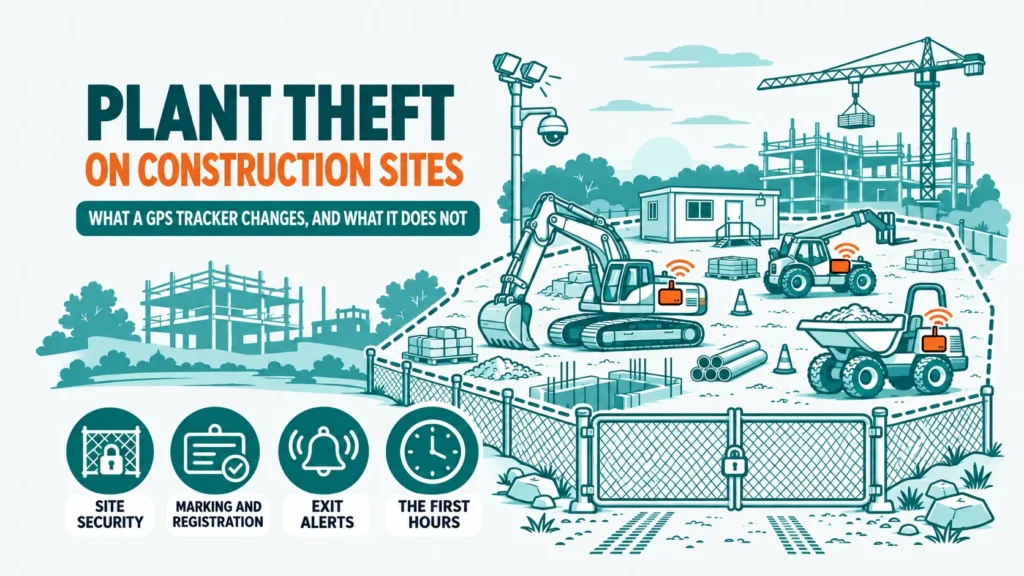
Plant theft and GPS tracking, the essentials
Plant theft is rarely opportunistic. Machines are taken to order, moved within hours and often shipped abroad. No single measure stops it. What works is layers: a site that is slow to enter, machines that are hard to start, marking and registration that prove ownership, and a hidden GPS tracker that tells you a machine has left and where it went.
A tracker does not immobilise a machine and does not bring it back. It shortens the time between the theft and its discovery, gives the police a location to act on, and so improves the chances of recovering it.
Monday, 6.45 am. The groundworks gang arrives to find the gate chain cut and a gap where the 3-tonne excavator stood on Friday evening. Nobody knows whether it went on Friday night or Sunday afternoon. If it was Friday, the thieves have a sixty-hour start, and the machine may already be in a shipping container. That gap between the theft and its discovery is the part of the problem a plant manager can actually shorten. The rest of this guide covers what to do before, and what to do after.
How big is plant theft in the UK and Europe?
Direct answer: No official statistic isolates plant theft, but police and trade-body figures describe an organised, export-driven crime. The UK's specialist police unit recovered £10.5 million of stolen plant and equipment in 2024, up from almost £6.3 million in 2023.
Those figures come from the National Construction and Agriculture Theft Team (NCATT), a small police unit formed in January 2023 and funded largely by the industry itself. They were published by the Construction Plant-hire Association and reported by Earthmovers Magazine on 2 April 2025, which also records 254 arrests in 2024. Read them for what they are. A recovery total measures police activity, not the number of machines stolen, and nobody publishes a reliable count of those.
The closest thing to a volume figure comes from the hire sector. In a briefing published on 11 July 2024, Hire Association Europe reported that between 40 and 70 high-value machines were typically stolen each month in the UK before the war in Ukraine, and that thefts had exceeded 110 machines a month over the 18 months before the briefing. The association links the rise to demand from Eastern Europe. It also describes a lorry stopped at Harwich late at night with eight suspected stolen machines on board, bound for Poland.
That last detail matters more than any total. A stolen excavator is not sold in the next town. It crosses a border, which is why plant theft is a European problem and not only a British one. We found no verifiable, dated total for continental Europe, so we give none here.
How do thieves take plant from a construction site?
Direct answer: Thieves use three main routes: forced entry outside working hours, theft from an unsecured yard or during transport, and fraudulent hire, where a machine is hired with a genuine company's details and never returned.
Nights, weekends and shutdown periods give the longest head start. Compact excavators, dumpers, rollers and telehandlers are favoured because they fit on a plant trailer or a beavertail lorry and can be loaded in minutes. A machine that starts with a common key is an easy target.
Machines are exposed when they wait for collection, sit on a low-loader overnight or stand in a subcontractor's compound that nobody on your team controls. Paperwork is weakest at exactly that moment.
The thief opens an account using a real firm's name and a real employee's details, takes delivery and disappears. Hire Association Europe notes that hiring a machine gives criminals time to find tracking technology and move the equipment out of the UK before it is reported stolen.
Hire fleets carry a large share of the risk. In the two NCATT operations reported in April 2025, all 36 recovered machines, valued at £350,000, had been taken from hire companies. If you run a hire desk, identity checks on new accounts belong in your theft plan as much as padlocks do. Our page on GPS tracking for equipment rental covers the fleet side of that problem.
One more category deserves a mention: the machine that was never stolen. A breaker left on another site, or a plate compactor that a subcontractor took home, costs you a replacement hire and a morning of phone calls all the same. A dependable record of where each asset last reported settles most of these cases without the police.
Which site measures reduce plant theft?
Direct answer: The measures that reduce plant theft are the ones that cost a thief time: a controlled perimeter, machines parked to block one another, keys removed from site, immobilisers or isolators, monitored CCTV and a fixed end-of-shift routine.
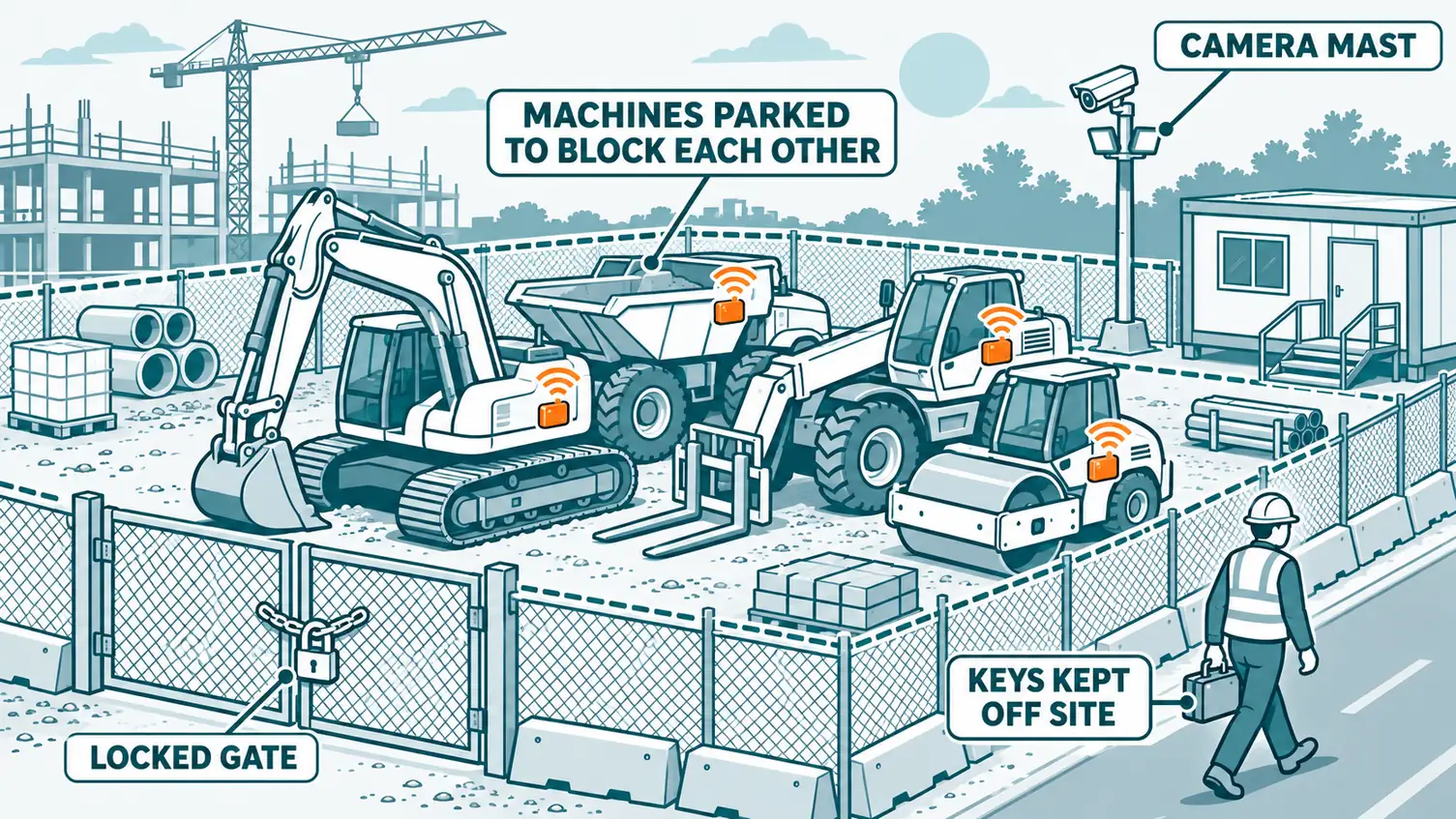
None of these is new, and none works alone. The table sets out what each layer does and where it stops.
| Measure | What it does | Where it stops |
|---|---|---|
| Perimeter, gates and a single vehicle entrance | Forces a noisy, visible entry and limits where a lorry can load | Fencing panels lift out; a chain is cut in seconds |
| Parking discipline | Large machines block small ones; buckets lowered, booms slewed against a wall or a container | Depends on the last operator of the day doing it every evening |
| Key control | No keys in cabs or site cabins; a signed key log | Useless if the machine starts with a common key |
| Immobilisers, battery isolators, track and hitch locks | Stops the machine being driven on to a trailer | A machine can still be lifted or winched |
| Lighting and monitored CCTV | Deters, and raises an alarm during the theft when someone is watching | Unmonitored recording only shows you the theft afterwards |
| Marking and registration | Proves ownership and complicates resale | Does not locate anything |
| Hidden GPS tracker with an exit alert | Tells you the machine has left and where it reports from next | Does not stop the machine; can be found or shielded |
The cheapest measure is the Friday routine. Write it down: who parks the plant, who removes the keys, who checks the gate, who confirms it by message to the contracts manager. Sites that are lost over a weekend are often sites where everybody assumed somebody else had locked up.
Brief your people as well. Thieves look before they take. An unfamiliar van photographing the compound, a caller asking which machines are on hire, a "delivery driver" with no paperwork: each is worth a note in the site diary and a call to the office.
✅ Before a long shutdown: move high-value compact plant back to the depot when you can, and ask the hire company to off-hire and collect machines you will not use. An empty compound cannot be robbed.
Why mark and register plant machinery?
Direct answer: Marking and registration make a machine identifiable in minutes, so the police can show it is stolen and return it. In the UK the main scheme is CESAR, owned by the Construction Equipment Association, with a database open to every police force around the clock.
Identification is the weak point of plant crime. A car has a registration plate and a national database behind it. An excavator has a serial plate held on by two rivets. The CESAR scheme, designed with the police in 2007 and launched in 2008, answers that with tamper-evident labels, microscopic datadots and a central record of each machine. According to the Construction Equipment Association (17 October 2025), over 80% of UK construction equipment manufacturers now fit CESAR as standard, and the scheme is approaching its 700,000th registered machine.
Do not assume the law does this for you. The Equipment Theft (Prevention) Act 2023 allows ministers to require marking and registration, but the government's conclusions, published in October 2025 and updated on 10 March 2026, limit the coming regulations to new all-terrain vehicles and removable GPS units. Larger machinery and hand-held power tools are left out for now. For construction plant, marking remains a voluntary decision by the manufacturer and the owner.
Whatever the scheme, the paperwork is yours to keep. For every machine, hold in one place:
Make, model, serial or product identification number, engine number, registration scheme number, and the identifier of any tracker fitted.
Four sides, the serial plate, and anything distinctive: a repaired panel, an aftermarket hitch, your livery. Thieves remove decals first, so photograph what they cannot peel off.
Purchase invoice or hire agreement, finance details and the insurer's policy number, so that a report made at 7 am does not wait for the accounts office to open.
Outside the UK, ask your dealer and your insurer which register the national police consult. The principle is the same everywhere: a machine that cannot be identified at the roadside cannot be seized there.
What does a plant machinery tracker change, and what does it not do?
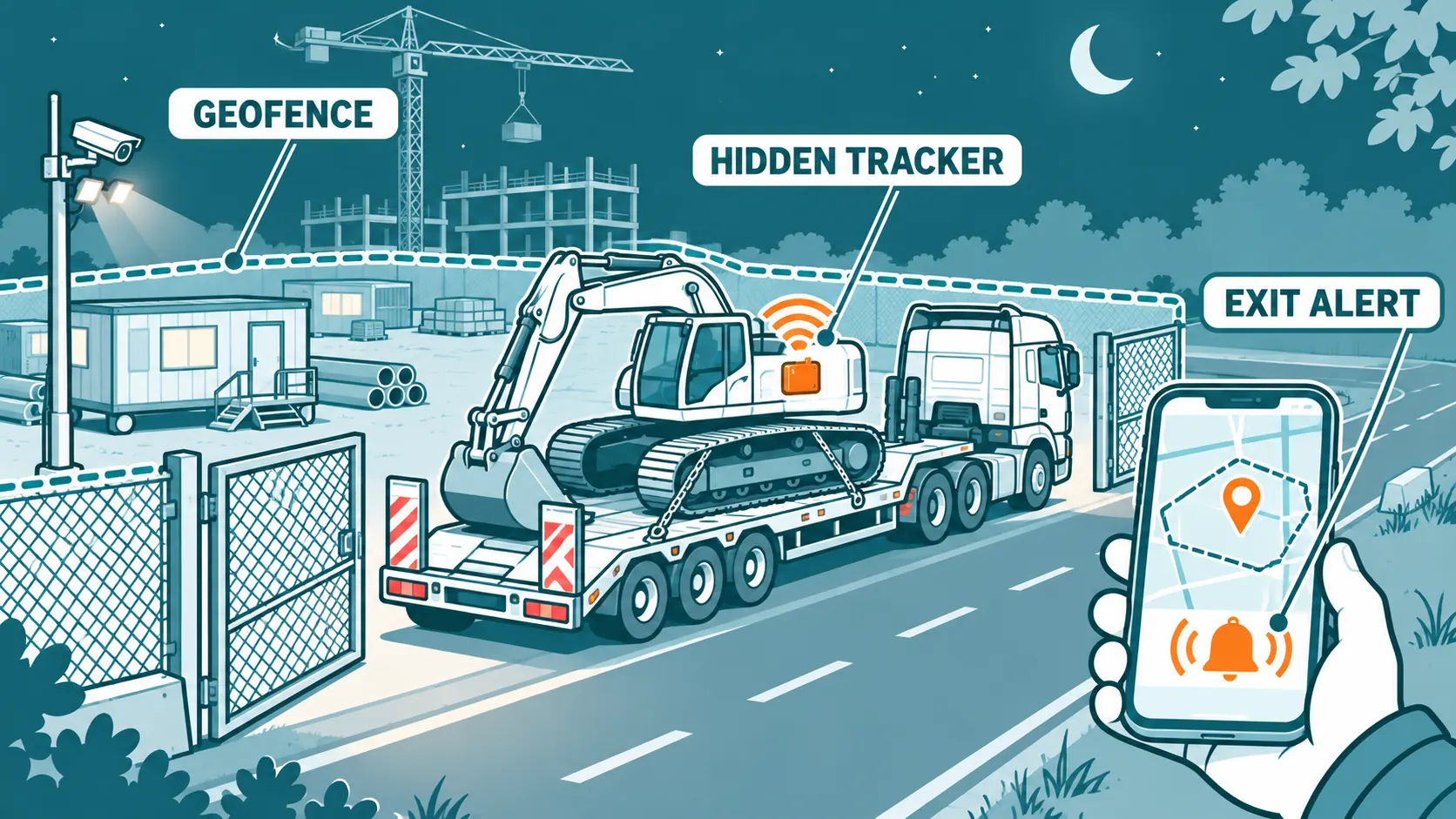
Direct answer: A hidden plant machinery tracker reports that a machine has left its site and where it goes next, so a theft is discovered within hours instead of on Monday morning. It does not immobilise the machine, cannot report where there is no signal, and can be found and removed.
| Question | With a hidden tracker | What stays the same |
|---|---|---|
| When do you learn of the theft? | When the tracker reports a position outside the site geozone and the exit alert is sent | Someone still has to read the alert at 2 am and act on it |
| Where is the machine? | At its last reported position, with the route recorded in the position history | No position from inside a steel container, underground or in an area with no network |
| Can the thief be stopped? | No | Locks, immobilisers and site security do that job |
| Will the police act? | They have a specific location and a history to work from | The response is their decision and depends on their resources |
| Will the insurer pay? | The history documents when and how the machine left | Cover depends on the policy wording, not on the tracker |
The mechanism is simple. You draw a geozone around the compound on the platform and attach an exit alert to it. When a tracked machine reports from outside that boundary, the named people receive the alert. With the Essential plan of the TRAKmy platform, geozones, entry and exit alerts, and the position history are included. Higher plans such as Professional add reporting and sensor data, which matter more for utilisation than for theft.
Be clear about cadence. A battery-powered tracker sends positions periodically and when it detects movement. It is not a continuous feed. That is the trade-off that lets it run for years with no wiring, and it is why the device belongs where a thief will not look. A wired unit connected to the machine's battery is the first thing a professional disconnects.
Which device for which asset? A short guide:
The ULTRA N (1141): NB-IoT with a built-in eSIM, IP68 / IP69K sealing, IK09 impact rating, a replaceable battery and up to 10 years depending on reporting frequency. No cable, so it can be hidden deep in the structure.
The ULTRA L+ (1105) adds LTE-M to NB-IoT, which suits mobile assets and cross-border work. The ULTRA N+ (1101) adds Wi-Fi positioning and sensors for assets that spend time in yards and buildings.
The COMPACT (1115) weighs 95 g and measures 105 x 54 x 21.5 mm, with a battery life of 3 to 8 years depending on the mode (manufacturer data).
The REACT (1215) is wired to the vehicle supply (10 to 30 V) and carries a replaceable backup battery, so it keeps reporting if the supply is cut.
Coverage depends on the network each tracker uses. Check the NB-IoT coverage page against the countries your machines work in before you choose. Positions and history are stored with data hosted in Europe.
⚖️ A change in English and Welsh law: the Crime and Policing Act 2026 amends the Theft Act 1968 so that police can enter and search premises to which stolen items have been electronically tracked, without a court warrant where obtaining one is not reasonably practicable. An officer of at least Inspector rank must authorise it. The Home Office factsheet (updated 30 September 2026) names GPS trackers fitted to machinery among the cases it has in mind.
Two cautions. First, a tracker on a ride-on machine or a van also shows where its operator is. In the UK, read the ICO guidance on monitoring workers and tell your staff what is tracked and why; elsewhere in Europe, check with your national data protection authority. Second, a sticker saying "tracked" deters the casual thief and tells the professional to start searching. Use both a visible deterrent and a device that is hard to find.
Sizing, fitting and pricing are covered on our GPS tracking for construction page, and the full range is on the products page.
What should you do in the first hours after a plant theft?
Direct answer: Confirm the machine is stolen and not transferred, report it to the police at once with its identifiers and last tracked position, do not go to that location yourself, then inform your insurer and the hire company and preserve the evidence.
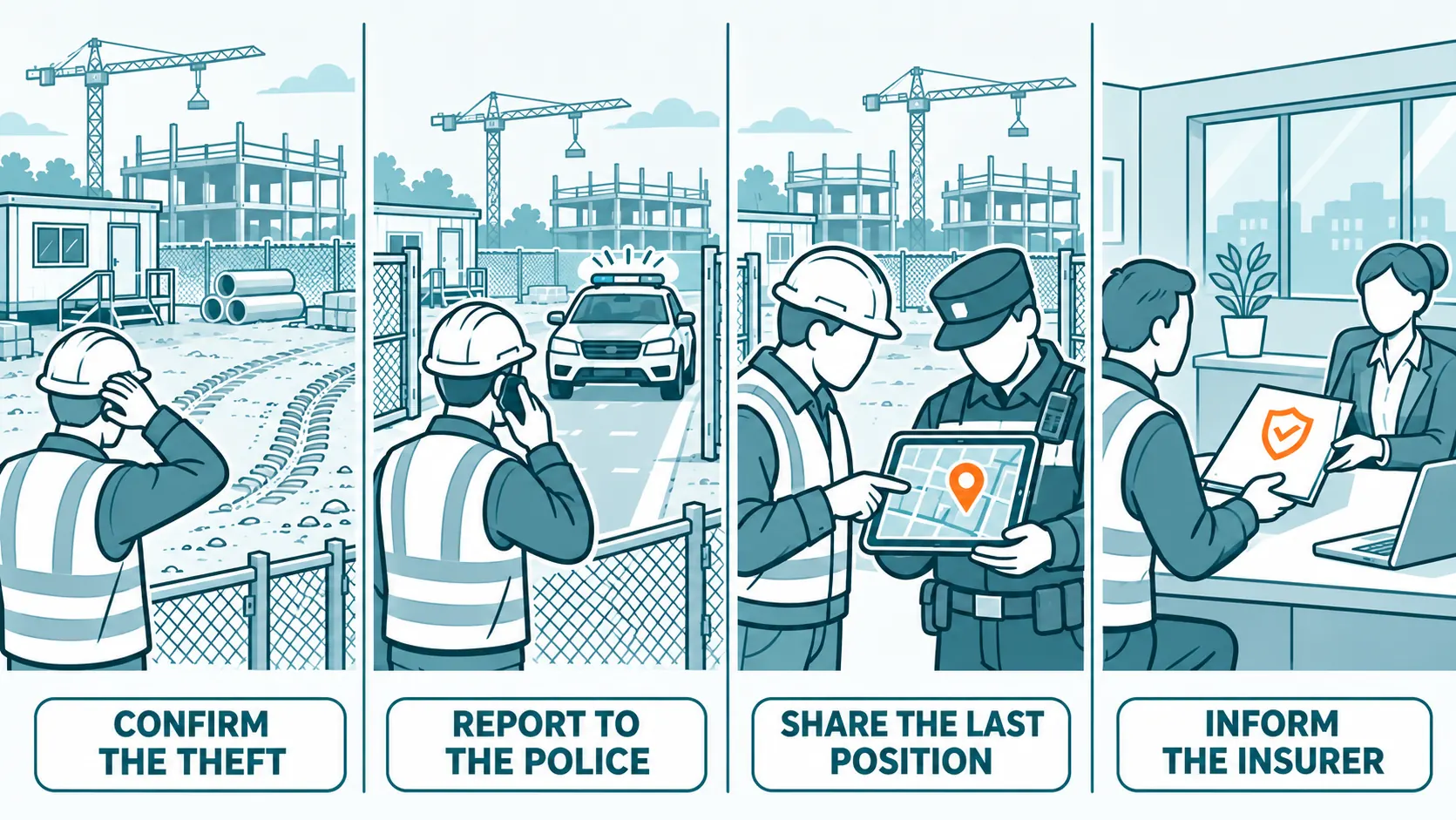
Speed decides the outcome, and so does order. Work through the steps below, and assign each one to a named person in advance.
| When | Action | Why |
|---|---|---|
| First 15 minutes | Rule out a transfer, an early collection by the hire company or a move to another site. Check the position history. | A false report wastes the goodwill you will need later |
| First 30 minutes | Report to the police: 999 in the UK if the theft is in progress, otherwise 101 or your force's online form. Give make, model, serial number, marking scheme number and the last tracked position. Ask for the crime reference. | Nothing else moves without that reference |
| First hour | Ask the officer to confirm that the machine is recorded as stolen with its serial number. Tell the tracking supplier and the marking scheme. | Roadside and port checks rely on that record |
| Same morning | Notify the insurer and, for hired plant, the hire company. Send photographs, proof of ownership and the position history. | Policies set notification deadlines; hire contracts make you responsible for the machine |
| Same day | Preserve the scene: cut chains, tyre marks, CCTV footage, the gate log. Note who was last on site. | CCTV systems overwrite quickly |
| Following days | Keep checking the tracker and pass every new position to the officer in charge. Review how the site was entered and fix it. | A site robbed once is often visited again |
⚠️ Do not recover the machine yourself. A position on a map is not proof of who is at that address, and the people who steal plant to order are organised. Pass the location to the police and stay available by phone.
Typical example. A civil engineering contractor leaves a tracked telehandler on a housing site on Friday. At 1.20 am on Saturday the plant manager receives an exit alert. The history shows the machine travelling east and then stopping at an industrial estate. He reports the theft with the serial number, the marking scheme number and the address. Whether the machine comes back depends on what happens next, and that is out of his hands. What has changed is that the police have a location on Saturday morning, not a blank on Monday.
If you manage tools and light plant for a smaller firm, the same sequence applies on a smaller scale. Our page on tracking for landscaping and trades looks at vans, trailers and the kit that lives in them.
What do plant managers ask most about plant theft and GPS tracking?
Direct answer: The most frequent questions cover whether a tracker stops plant theft, where to fit it, whether thieves can defeat it, whether to recover a machine yourself, and whether UK law requires marking or tracking.
Does a GPS tracker stop plant theft?
Where should a tracker be fitted on an excavator or a telehandler?
Can thieves find or block a plant machinery tracker?
Should I go and collect a stolen machine when the tracker shows where it is?
Does UK law require construction plant to be marked or tracked?
A tracking plan built from your plant list
Send us your plant list and the countries your machines work in. We will tell you which tracker suits each asset, where it will and will not report, and prepare a tailored quote.